


Important: It is not recommended to adhere to the diet without first consulting your doctor.This rule is relevant not only for those who have identified diseases, but also for everyone else.
Unlike most currently popular diets, the goals of the ketogenic diet from the beginning were purely medical.They remain the order of the day even today.In general, initially the word “diet” had nothing to do with weight loss.This word means a set of nutritional rules that must be followed in a certain situation - during the treatment of a certain disease, during the period of postoperative therapy.
The keto diet owes its renewed popularity largely to an American film producer, whose son had been suffering from epilepsy for a long time.Despite numerous visits to the most famous and outstanding neurologists, who tried, it seems, all the most effective antiepileptic drugs existing in nature, the boy's condition did not improve at all.The father, almost desperate, read a lot of literature on the topic of epilepsy treatment in the local library and suddenly came across a description of the ketogenic diet, which had not yet been recommended to him by any specialist.He immediately put his son on this diet and, to his delight, found that the boy's seizure frequency was significantly reduced.
Hence, the ketogenic diet was invented to reduce the frequency of seizures, especially in children.There was no reduction in calorie intake;carbohydrates were simply replaced with fats.The children were placed on this diet for 36 hours and the frequency of their seizures actually decreased.
The ketogenic diet is now used to treat not only epilepsy, but also Alzheimer's disease, fatty liver disease (fatty liver), and even some types of cancer.Overall, its medical benefits are undeniable.How about losing weight?

The ketogenic diet is a diet composed of meals very high in fat (animal fats and some vegetable oils), animal proteins and very few carbohydrates, so that approximately 80% of the body's energy needs are met by the breakdown of fat (the fat content of the average European's diet provides 30-35% of the energy the body needs during the day).And similar to what happens during fasting, the breakdown of large amounts of fat leads to increased acidity in the body.This can probably explain why the use of such a dietary complex leads to a decrease in the frequency of epileptic seizures.
The goal of the ketogenic diet is to put the body into a state of ketosis.
Ketosis is a pathological state of the body in which ketone bodies predominate in its tissues.The state of ketosis means that the body exclusively uses the fat stored under the skin to cover its energy needs, thus avoiding muscle breakdown.While you're in a state of ketosis, you'll draw energy from ketones, carbonyl compounds that form when fats are broken down.By the way, ketones are an excellent source of energy for the brain, almost perfectly replacing glucose.
Another positive feature of ketosis is that in this state you practically will not feel hunger, so you will eat less, which means you will not fully cover your energy costs.
To bring the body into a state of ketosis, the diet is structured in such a way that fats and predominantly saturated fats clearly prevail in the diet (the diet consists of 90% fat, based on calorie content).
In fact, the diet that many professional bodybuilders follow in the last week before a competition can even be called ketogenic: it consists only of salmon (usually grilled, but can be prepared in other forms), peanut butter and green vegetables (lettuce, broccoli, spinach, cabbage).It is even better to add flaxseed oil or walnut oil to this diet.There is already much more protein here, which reduces the problems, but does not eliminate them completely.
Pros and cons of the classic ketogenic diet
The advantage is that this diet is very effective, the diet works and how!The main thing is that you practically will not feel the feeling of hunger, which means that calorie restriction in your diet will be quite easy to tolerate.Ketones are an excellent source of energy for the brain.
It is also important that the ketogenic diet reduces the risk of cardiovascular disease due to a strong decrease in insulin secretion.But for people leading an active lifestyle, this plus can easily turn into a minus, because insulin is a powerful anti-catabolic agent.A decrease in insulin secretion overlaps with the ability of a ketogenic diet to cause acidosis in the muscles, which means that it increases proteolysis, i.e. the breakdown of the body's proteins is facilitated.And catabolism can spiral out of control.Not immediately, of course, but certainly within 3-4 days.
It is simply impossible to follow the classic ketogenic diet for a long time - you start to feel bad in the most natural way.It is not for nothing that for children suffering from epilepsy the ketogenic diet was limited to a period of 36 hours.
The ketogenic diet is currently used to treat some types of cancer.Specifically, prostate cancer takes advantage of the diet's ability to reduce the production of IGF-1 (insulin-like growth factor 1).
Another disadvantage is a decrease in the level of free testosterone in the blood plasma.
The main danger of the keto diet is the increase in ketone levels in the blood, which lowers the acidity (pH) level of the blood and can cause death in extreme cases.This condition is called “ketoacidosis”.First of all, this applies to people with severe and moderate forms of diabetes.If it is not present, there is no reason to worry, since the blood of healthy people contains exactly as many ketones as the body can process.
It takes time for the body to give up glucose and learn to feed the brain with ketone bodies, so the level of physical and mental activity may decrease in the first week.The main symptoms are lethargy, dizziness and mental fog.
Many people experience this condition extremely painfully and "give up" literally on the second day.But the state of health returns to completely normal on the third to fifth day, when the body is rebuilt.
The lack of fiber causes a slowdown in intestinal function.The main point of the ketogenic diet is complete abstinence from carbohydrates.Accordingly, the diet should consist of proteins and fats, and fiber is a complex carbohydrate.You can take fiber in its pure form and simply include green vegetables or lettuce leaves in your diet, which contain a large amount of coarse dietary fiber.
An important disadvantage of the diet is the deficiency of microelements caused by the exclusion of carbohydrate-containing foods from the diet.Essentially, any meat or dairy products recommended on a ketogenic diet do not contain most vitamins or minerals.The best way to avoid deficiencies is to take vitamins and minerals, dietary supplements containing minerals.Numerous minerals, such as zinc or magnesium, are essential for the functioning and hormone levels of the body.
Contraindications
Ketogenic diets are contraindicated in the presence or history of liver disease, kidney disease, metabolic disorders (including congenital and genetically determined metabolic disorders), progressive encephalopathy, as well as diabetes mellitus, cardiovascular diseases, cerebrovascular and lipid diseases, as well as during simultaneous intake of drugs based on valproic acid (valproate).There are currently no known contraindications to its use.
When prescribing a ketogenic diet, the diet for each child and adult is calculated only by a doctor!Strictly individually, taking into account the diagnosis, age and weight of the child, his nutritional needs.The content of basic nutrients (proteins, fats, carbohydrates) in foods is selected in a certain ratio, determined only by a specialist!During treatment, this ratio may change, so constant monitoring of the patient by the attending physician is necessary, who, if necessary, makes dietary adjustments.The patient's diet includes various types of fatty foods: bacon, cream, vegetable oils, such as flaxseed.In countries where the ketogenic diet is widely used, the food industry produces many special products that can provide a varied and nutritious menu.
For those starting a course of treatment, nutritionists have developed special milkshakes with a large amount of fat, which can not only be drunk, but also eaten frozen like ice cream.This helps the child get used to fatty foods and creates the necessary biochemical changes in the body that provide an antiepileptic effect.During treatment, the doctor requires great skill in creating a menu, otherwise the child will quickly get bored with a monotonous diet and may refuse to eat at all.During various diseases, such as colds, the metabolism always changes.This could make the ketogenic diet less effective.In such conditions, you should definitely consult your doctor so that he can adjust the menu.
What can you eat on a ketogenic diet and what advice should you follow?
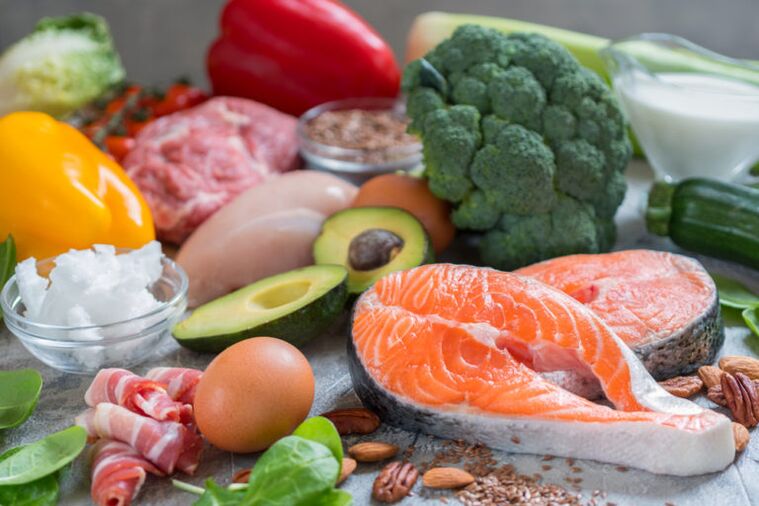
The ketogenic diet focuses on foods rich in protein and fat.It is important that moderate fat consumption is healthy and even necessary, because it is fats that cause a lasting feeling of satiety.
Fats can be divided into three groups:
- saturated fats (present in red meat and dairy products);
- unsaturated (present in vegetable oils and vegetables);
- monounsaturated (present in fish and olives).
Fats perform many functions in the human body:
- energy (with a lack of calories, fats can be broken down, providing the body with energy);
- protective (all organs are covered with a thin layer and have high thermal insulation properties);
- construction (part of cell membranes);
- enzymatic (some lipids are part of cofactors);
- hormonal (some lipids are part of hormones and mediators).
The best choice would be foods rich in proteins: meat, fish, milk, cottage cheese, eggs, cheese and their derivatives.Carbohydrates are acceptable, but only in small quantities.For digestion, 30-50 grams of fiber will be sufficient.
All products containing starch (cereals, pasta, potatoes) and sugar in any form are strictly not recommended.Almost all fruits contain a lot of sugar in one form or another, so they are also prohibited.It is always necessary to look at the composition of the product on the label, because even a glass of milk contains about 15 grams of carbohydrates.Furthermore, a list of basic food additives is being studied, which will also have to be excluded, if only because they are harmful.
To aid weight loss, drink plenty of water.Water helps the body burn more calories and prevents constipation.Limit your caffeine intake.Exercise regularly.
Exercise will help you lose fat faster on a ketogenic diet.Walk, bike, run in the park or workout at the gym.Incorporating physical activity into your daily schedule can help you maintain a healthy heart and lose weight.
Sleep well at night.In the early stages of ketosis you may feel very tired.Sleep at least 7-8 hours a night to restore energy.Good rest will also promote weight loss.
Contact your doctor if you experience cold-like symptoms.Many people feel tired and have a slight headache during ketosis.Sometimes side effects become serious enough to require medical attention.
When does the diet take effect?
The effect of using the ketogenic diet manifests itself gradually during the first 3 months after starting.Long-term treatment is typically required (over several years, usually 2-3 years), after which stable improvement is generally observed, which persists even with a normal diet.Therefore, it is not necessary to follow a ketogenic diet for life.
In many cases the positive effect is already noticeable in the first or second week of treatment.However, sometimes within one or two months of using the diet no effect is noticed: in this case it is too early to draw conclusions about the ineffectiveness of the treatment;perhaps the doctor needs to calculate the biochemical parameters more carefully.
In the generally accepted interpretation, this is largely a variation on the theme of therapeutic fasting followed by a “load” of ketosis-inducing foods.For the first three days of therapy it is necessary to completely refuse any food and limit yourself only to drinking water in any quantity.Mineral water and artificially sweetened drinks with and without carbonated water, as well as juices, are prohibited.You can drink green tea.The water can be boiled or purified.During this period it is necessary to reduce the patient's physical activity;sometimes bed rest is indicated.For the next three days you should slowly introduce food, a quarter of the usual portion.When choosing foods, you should be guided by the principle of 4 parts fat to one part protein and carbohydrates.
The menu is somewhat reminiscent of the so-called fatty diets for weight loss.The main thing is to completely exclude foods such as cereals, fruits, ordinary bread, carrots, beets, potatoes and pasta.
Complications
As with any therapeutic method, the use of the ketogenic diet is in some cases associated with some adverse reactions, the main ones listed below.
- Hair loss.Some children experience hair loss or sparse hair growth after long-term use of the ketogenic diet.This complication is believed to be associated primarily with a deficiency of minerals in the diet.
- Delayed linear growth.This type of physical development disorder has been recorded in some patients, but its connection with the ketogenic diet continues to be debated today.Increased levels of cholesterol and triglycerides in the blood.The ketogenic diet, composed of almost 90% fat, in some cases leads to an increase in cholesterol and other lipids in the blood.For any lipid content (cholesterol - more than 800 mg%, triglycerides - more than 1000 mg%), interruption of the diet is not necessary.Reducing the fat/protein/carbohydrate ratio from 4:1 to 3.5:1 usually results in rapid reduction of lipid levels to acceptable levels.
- Kidney stones.This complication of the ketogenic diet affects approximately 1 in 6 patients. It is believed to occur due to inadequate fluid intake in children.Therefore, when following a ketogenic diet, a urine test is performed to determine density and detect blood impurities.If necessary, an ultrasound examination of the kidneys is performed.
- Drowsiness and lethargymay occur due to excessive ketosis or toxicity of concomitantly used antiepileptic drugs.Blood levels of drugs can increase during a ketogenic diet even without increasing the dosage of the drug.For this reason it is necessary to control its concentration in the blood and promptly reduce the dose of potentially sedative drugs such as phenobarbital and benzodiazepines.
- Constipation, as a rule, are explained by relatively small food portions when following a ketogenic diet and limited water consumption.Increasing the daily volume of liquids consumed by 100-150 ml helps to avoid defecation disorders.
- Excess body weightpatients is caused by consuming too many calories rather than too much fat.Therefore, the energy content of the diet when prescribing a ketogenic diet must be adapted to individual needs.
- Weight loss.This point can be explained by some individual metabolic characteristics, as well as the patient's level of physical activity.If it is found that the child's body weight has decreased by 400-500 g in 1 month, the energy capacity of the diet can be increased by about 100 kcal per day.It should be remembered that when increasing the calorie content of the diet of young children or patients with a low level of physical activity, it is not necessary to increase the amount of energy consumed at a time by more than 25 kcal.

We remind you once again that your personal menu for this diet should be compiled by a specialist!
When using a ketogenic diet, a thorough clinical and laboratory examination of patients with recording of EEG and ECG data, as well as a biochemical blood test is necessary before the start of treatment.